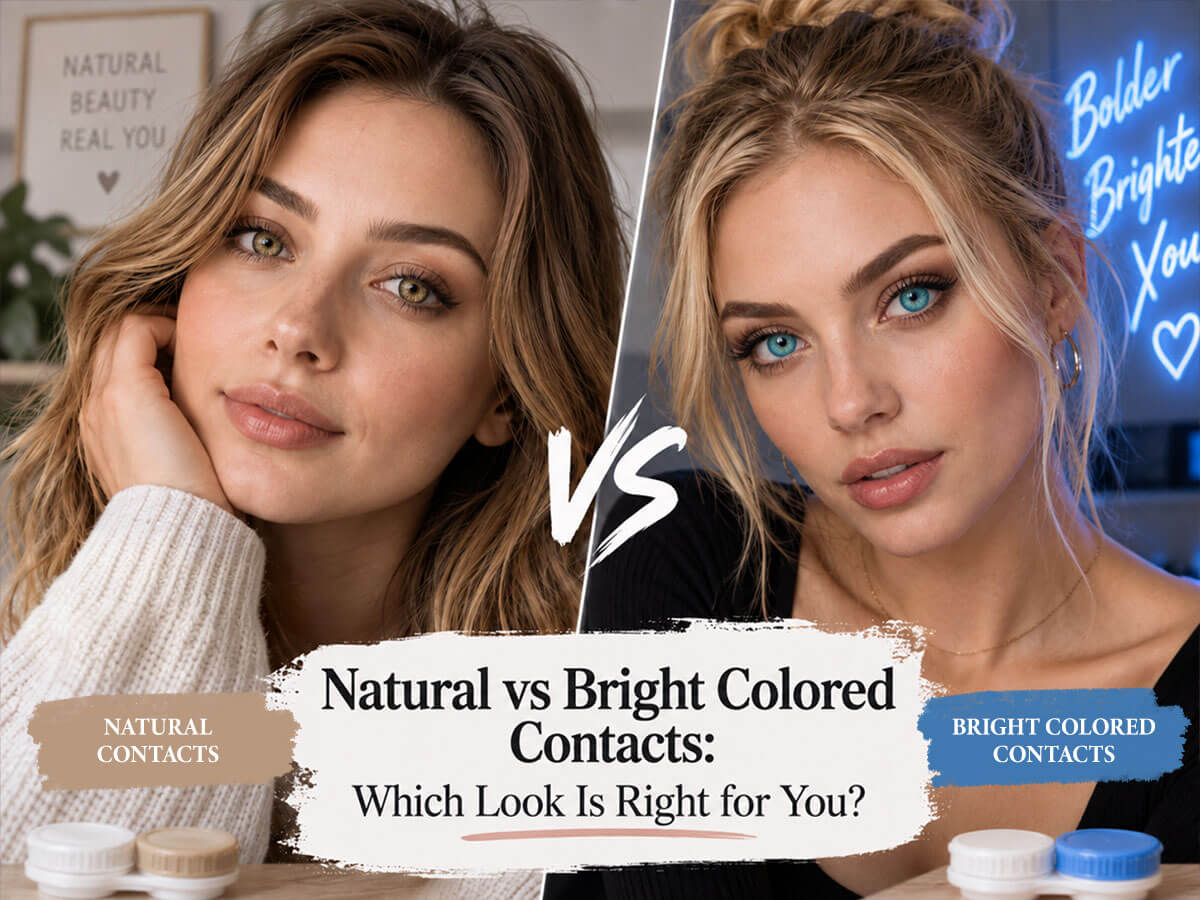
Natural-looking and bright colored contacts are not rigid lens categories. They describe points on a visual spectrum. The result depends on opacity, color saturation, iris pattern, edge contrast, lighting, and your natural eye color.
This guide helps you compare those visual features and choose the level of change you want. Visual style does not determine whether a lens is safe, comfortable, prescription-free, or suitable for a first-time wearer.
Turn Your Preferred Effect Into Two Product Pages
A natural or bright label is a starting point, not a measured intensity score. Compare two actual designs using the same questions: How defined is the outer edge? How sharp is the transition around the pupil? How much contrast does the lens create against the whole face?
| Your comparison | Product pages | What to check |
|---|---|---|
| Two grey designs | Ivy Grey and Moonmist Grey | Both labeled 1 Year / 2 lenses. Compare the actual print and outline rather than assuming one grey name means a fixed brightness. |
| A brown or green direction | Dioren Brown and Dioren Green | Both labeled 1 Year / 2 lenses. Compare color contrast separately from the fitted specifications. |
| A single-use routine | Selene Grey Daily and Selene Blue Daily | Both labeled 1 Day / 2 lenses. A replacement routine does not establish how subtle or bright the effect will look. |
These are GLEGLOW shopping examples, not an independent ranking or a guarantee of coverage, fit or comfort. Confirm current product details and Power availability. Photos are not a controlled same-wearer, same-lighting comparison.
If your starting iris is dark brown, use the dark brown eyes comparison guide. If you want help diagnosing an obvious outline or weak color, use the visible-result checklist.
Natural-Looking vs Bright: What Changes?
Natural-looking designs usually aim for softer integration with the wearer’s iris. They may use blended tones, fine radial details, a subtle limbal ring, or lower-contrast edges. Bright designs usually aim for greater visibility and may use stronger saturation, more contrast, or more opaque pigment.
These features can overlap. A saturated lens can still have a detailed iris pattern, while a natural-looking lens may use enough opacity to remain visible on dark eyes. Always judge the individual product images and specifications instead of relying only on a style label.
| Visual preference | Features to compare | What it does not determine |
|---|---|---|
| Subtle, blended change | Soft edge, layered tones, lower contrast, fine iris detail | Prescription requirement, fit, safety, or comfort |
| Clear, noticeable change | Higher saturation, stronger contrast, more visible pattern or coverage | Prescription requirement, fit, safety, or comfort |
| Balanced effect | Moderate opacity and contrast with a detailed pattern | Whether the lens is suitable for your eyes |
How Your Natural Eye Color Affects the Result
The same lens can look different from person to person. Your natural iris color combines with the printed pattern, especially where the design is translucent. Lighting, pupil size, makeup, camera settings, and screen color can also change the perceived result.
On dark brown eyes, a more opaque or higher-contrast design may create a more visible change, but opacity alone does not guarantee a flattering or natural result. On lighter eyes, translucent designs may blend more visibly with the natural iris, but the final color still varies. Product photos are useful references, not guarantees of an identical result.
Choose by the Effect You Want
For a softer result
Compare designs with blended transitions, fine iris details, and a soft outer edge. Explore the Natural Collection and review each product’s images, replacement schedule, available powers, and specifications.
For a more visible result
Compare saturation, opacity, pattern contrast, and limbal-ring definition. Explore the Brighten Collection.
For a balanced result
Look for a design that combines visible color with detailed patterning and moderate edge contrast. The best choice depends on your natural iris and desired effect—not a universal rule about skin tone, makeup, workplace, or occasion.
Style, Fit, and Comfort Are Separate Decisions
Natural-looking lenses are not automatically better for beginners, offices, weddings, or everyday wear. Bright lenses are not limited to nightlife, cosplay, or photo shoots. Choose a visual effect that fits your preference and environment.
Color intensity does not determine comfort. Comfort and suitability depend on factors such as professional fitting, lens parameters and material, replacement schedule, eye health, wear time, and proper care. If you are new to contact lenses or experience discomfort, consult an eye-care professional.
For a more technical explanation of pattern and coverage, read Enhancement-Style vs Dramatic Colored Contacts: Which Looks More Natural?
Prescription and Safety Information
For U.S. customers, all contact lenses—including decorative 0.00/Plano lenses—require a valid contact lens prescription and professional fitting. A 0.00/Plano lens has no corrective power; that does not remove the prescription requirement.
Use Prescription Verification to provide the requested information. The document check does not replace an eye examination or professional fitting.
GLEGLOW lenses are FDA Approved and produced in CE-certified facilities. Follow the prescribed replacement schedule and your eye-care professional’s instructions. Do not sleep or nap in GLEGLOW colored contacts. Stop wearing the lenses and seek professional advice if you experience pain, redness, or persistent irritation.
Shop and Compare
- Shop Natural-Looking Contacts
- Shop Bright Contacts
- ANY 5 FOR $55 applies to eligible regular-price YEARLY, MONTHLY, and 6-MONTH styles. Daily lenses are excluded.
- Read Customer Reviews and visit GLEGLOW’s official Trustpilot profile.
U.S. Order and Delivery Information
For U.S. customers, orders with complete prescription information are generally processed within 24 business hours. Estimated delivery is typically 9–15 business days after dispatch. A dispatch email is sent when the order ships, and you can check progress through Order Status. This delivery estimate is specific to U.S. customers.
Frequently Asked Questions
Can bright colored contacts look natural?
They can look more blended when the pattern uses detailed transitions and a softer edge, but a highly saturated or high-contrast design will usually remain more noticeable. Review the individual design rather than relying only on the word “bright.”
Which style is better for first-time wearers?
Neither visual style is universally better. First-time wearers should prioritize a valid prescription, professional fitting, correct lens parameters, eye health, and proper handling. After those requirements are met, choose the visual effect you prefer.
Are natural-looking contacts more comfortable?
Not necessarily. Color intensity does not determine comfort. Fit, material, lens parameters, replacement schedule, eye health, care, and wear time are more relevant.
Can I wear bright contacts at work?
That depends on your personal preference and the dress expectations of your workplace. The visual style does not change the prescription, fitting, or care requirements.
Are natural-looking contacts more expensive?
Pricing varies by individual product, replacement schedule, prescription options, and current promotion. Check the current product page rather than assuming one visual style costs more.
Final Choice
Start with the effect you want, then compare opacity, saturation, pattern, and edge contrast on individual product pages. Remember that the final appearance varies with your natural iris and lighting. Once you find a preferred look, confirm the prescription, fitting, parameters, replacement schedule, and care requirements before ordering.
Final Check: Product, Power, Pack
- Confirm the exact fitted product and current contact lens prescription. Use the prescription selection guide before selecting Power.
- Check each eye's Power and current specifications. Matching Power alone does not make different lenses interchangeable.
- Confirm replacement schedule and pack contents. Two lenses are not two pairs; verify pack configuration and quantity for different powers.
- Recheck product, Power and quantity in your cart. For routine questions, read the daily vs yearly guide.