
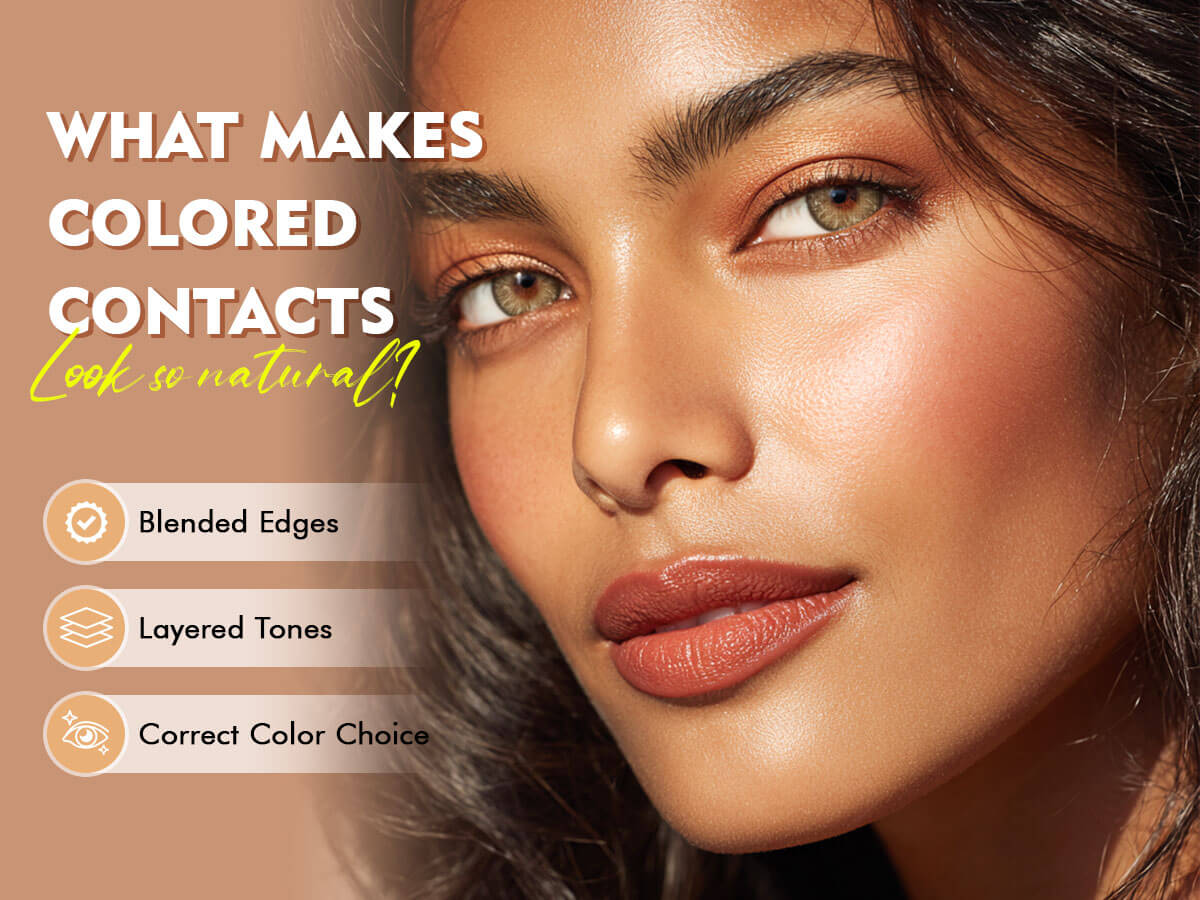
Colored contacts can look natural, but no shade name guarantees the result. Your starting iris, the printed design, lighting and the amount of change you prefer all matter. Compare a specific pair on a similar eye color, then confirm fit and prescription separately from appearance.
Will People Notice I Am Wearing Colored Contacts?
There is no reliable promise that other people will not notice. A close-up, a video call and an ordinary conversation can give different impressions. Decide whether your goal is almost no visible change, a defined outline or a clear color refresh. Check the full-face photo before inspecting the close-up.
Start With Your Main Question
| Your question | What to compare | Next step |
|---|---|---|
| Will the color show on dark brown eyes? | The result on a similar deep brown starting iris and the transition near the pupil. | Natural Contacts for Dark Brown Eyes |
| Will it work with little makeup? | The amount of full-face contrast and outer-ring definition with styling close to your routine. | Without-makeup shortlist |
| What should I compare for work? | Whether you like the appearance for meetings as well as on camera. | Office product shortlist |
| Why does blue or green look too bright? | Printed-color contrast, outer edge and lighting. | Blue design comparison or green design comparison |
Three Designs to Begin Your Comparison
- Dioren Brown — 1 Year, 2 lenses: compare a brown direction with your original iris.
- Vaelis Hazel — 1 Year, 2 lenses: compare a hazel shift against your brown candidate.
- Ivy Grey — 1 Year, 2 lenses: compare a cooler direction and its full-face contrast.
These are comparison candidates, not a prescription recommendation or a guarantee of naturalness. Open two product pages, compare current photos and details, then keep the design with the amount of change you prefer. Explore the natural-looking collection for more options.
What Product Photos Can and Cannot Tell You
Look for a starting iris close to yours. Compare the full face, outer ring and transition near the pupil. Indoor and daylight examples are useful where available, but no single photograph predicts your result. Published product photos may use different models, makeup, lighting, crops or editing. They are not a controlled same-wearer test or evidence of fit and comfort.
Use the brown-eye comparison guide or grey guide when you want to narrow the color direction. A brown, hazel or grey name alone is not a ranking of naturalness.
Before Your First Purchase
- Confirm a valid contact-lens prescription and professional fitting for the exact lens. In the United States, this also applies to zero-power cosmetic lenses.
- Check current Power for each eye, product specifications, replacement label and pack contents. Two lenses means two individual lenses, not two pairs; confirm pack configuration if the eyes need different Powers.
- Compare care and replacement routines using the daily vs yearly beginner guide. A yearly label does not permit continuous wear.
- Read customer reviews and prescription verification, then review product, Power and quantity in the cart.
Do not choose a different base curve, diameter or prescribed brand to change the appearance. Follow the fitted product instructions and professional guidance. See Wear & Care.
FAQs
Are natural-looking contacts always brown?
No. The exact design, original iris and preferred amount of change matter. Compare photographed results rather than choosing by color family alone.
Does a small graphic diameter guarantee a natural look?
No. It describes the printed area, not clinical fit or the final appearance on every eye. Compare the printed outline and whole-face effect, and confirm fit professionally.
Where should a beginner start?
Choose one everyday situation and two designs to compare. The first-pair guide connects those questions to a product shortlist and purchase checks.