
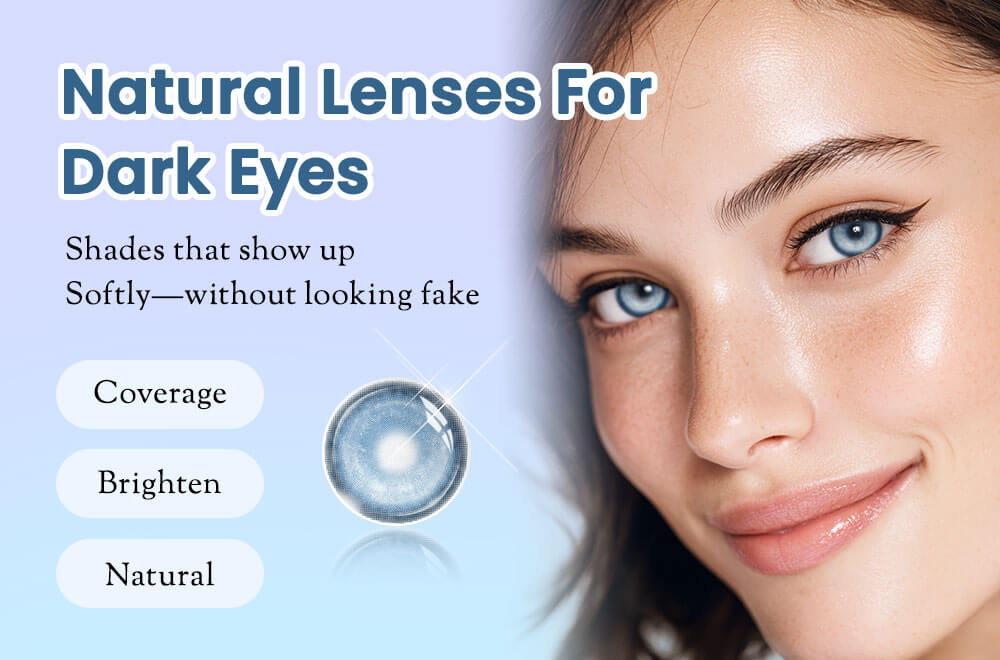
People with dark eyes usually don’t worry about whether colored contacts will look too strong.
They worry about whether the color will show at all — or worse, show in the wrong way.
If you’ve ever tried colored contacts on brown or dark eyes and felt disappointed, you’re not alone.
The issue isn’t your eyes. It’s how most lenses are designed.
Why Dark Eyes Are Harder to Work With
Dark irises contain more melanin, which absorbs light and color.
This means lightly tinted or semi-transparent lenses often disappear completely once worn.
On the other hand, lenses designed to “solve” this problem sometimes overcorrect — using heavy, flat pigment that masks the iris entirely. That’s when eyes start to look artificial.
Natural results sit somewhere in between.
The Opacity Myth: More Isn’t Always Better
Many people assume dark eyes need maximum opacity.
In reality, they need balanced opacity.
The most realistic lenses for dark eyes:
-
Use enough pigment to be visible
-
But still allow subtle iris texture to show through
-
Avoid chalky or overly bright tones
This is why muted grays, warm browns, soft greens, and low-saturation blues tend to work better than vibrant, high-contrast colors.
Why Flat Colors Look Fake on Brown Eyes
Flat pigment is the fastest way to make colored contacts look unnatural.
Real irises aren’t one color — they’re layered.
Good lenses replicate this with:
-
Multiple tones
-
Gradual transitions
-
Softer inner and outer edges
Many everyday collections designed for natural wear, including muted gray and brown styles often seen in brands like GleGlow, focus on this layered approach rather than bold coverage.
Dark Eyes Need Soft Edges More Than Light Eyes
Harsh limbal rings are especially noticeable on dark eyes.
Instead of enhancing the eye, they create a visible “circle” effect.
Soft-edge designs allow the lens to blend gradually into the white of the eye, making the color change feel intentional — not printed.
Choosing Colors That Actually Work
For dark eyes, the most reliable natural shades are:
-
Warm browns (enhancing rather than replacing)
-
Soft grays (cooling the eye without washing it out)
-
Muted greens (olive or forest tones)
-
Balanced blues (never neon or icy)
These tones tend to show clearly while staying believable in daylight.
Final Thought
Natural colored contacts for dark eyes aren’t about turning brown eyes blue overnight.
They’re about subtle shifts — depth, brightness, softness.
Once you stop chasing brightness and start choosing balance, everything changes.