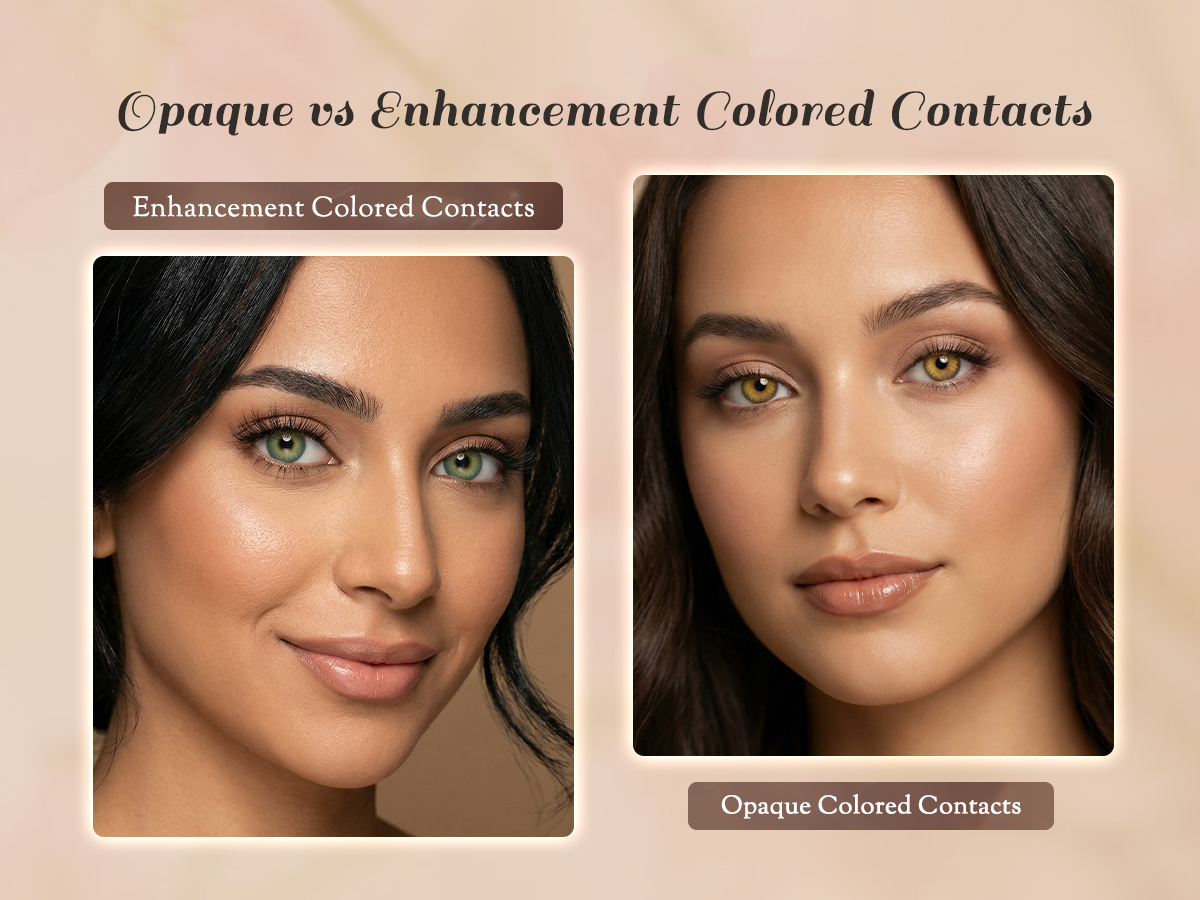
When choosing colored contacts, one of the most important differences is between opaque lenses and enhancement lenses.
Both can change the way your eyes look, but they work very differently.
If you have dark eyes, this difference matters even more.
Quick Answer
Opaque colored contacts are designed to cover your natural eye color and create a stronger color change.
Enhancement lenses are designed to deepen or subtly improve your natural eye color.
Start with your intended color change, then compare actual designs. Opacity describes coverage; it does not guarantee a natural-looking result or beginner suitability.
Compare Actual Designs Before Choosing an Opacity Label
Use the product photos to compare the outer edge, pattern near the pupil and the full-face result. These pairs are shopping starting points, not measured opacity rankings or a promise of the same result on every eye color.
| Your comparison | Open two product pages | What to check |
|---|---|---|
| Brown versus hazel | Color contrast against your own iris and the visible outer edge. | |
| Two gray designs | Pattern detail and the transition around the pupil; gray alone does not specify coverage. | |
| Single-use hazel versus gray | Compare the design first, then check the exact product and Power options. |
For more options, browse natural contacts for dark brown eyes or natural colored contacts. If a color looks too strong, use the enhancement-style versus dramatic guide to compare edges and contrast.
What Are Opaque Colored Contacts?
Opaque colored contacts use stronger pigment to cover the natural iris color.
They are best for:
- dark brown eyes
- dramatic eye color change
- blue, gray, green, or light-colored looks
- photography
- cosplay or fashion looks
Opaque lenses are usually the best option if your natural eye color is very dark and you want the lens color to show clearly.
What Are Enhancement Colored Contacts?
Enhancement lenses are more subtle.
They do not fully cover your natural eye color. Instead, they add depth, brightness, or definition.
They are best for:
- natural daily wear
- subtle beauty enhancement
- brown or hazel looks
- people comparing a subtle visual change
- users who want people to notice their eyes, not their lenses
Opaque vs Enhancement Contacts: Main Differences
| Feature | Opaque Contacts | Enhancement Contacts |
|---|---|---|
| Color Effect | Stronger change | Subtle change |
| Best For | Dark eyes, bold looks | Natural daily looks |
| Visibility | High | Low to medium |
| Style | Dramatic or noticeable | Soft and realistic |
| Beginner-Friendly | Depends on shade | Check fit, handling and the exact design |
Opacity Is Not the Same as Prescription Power
Opaque and enhancement describe how much of your natural iris shows through. They do not determine whether a lens corrects vision. Either style may be offered in 0.00/Plano or corrective powers.
For U.S. customers, all contact lenses—including 0.00/Plano decorative lenses—require a valid contact lens prescription and professional fitting. Review the GLEGLOW Prescription Verification process before ordering. Submitted prescription information is checked for completeness, readability and apparent validity for order processing; this review does not replace a professional eye exam. Learn more in our safe shopping guide for 0.00/Plano colored contacts.
Which One Is Better for Dark Eyes?
For dark eyes, opaque lenses usually show better.
However, this does not mean they always look more natural.
The best option depends on your goal:
- Want blue, green, or light gray eyes? Choose opaque lenses.
- Want a natural brown, hazel, or soft glow effect? Choose enhancement lenses.
- Want both visible and natural? Choose medium-opacity blended lenses.
How to Choose Between Opaque and Enhancement Lenses
Choose Opaque If:
- your eyes are very dark
- you want noticeable color change
- you want blue, gray, or green contacts
- you want your lenses to show clearly in photos
Choose Enhancement If:
- you want subtle beauty
- you have compared the exact design on an eye color similar to yours
- you prefer natural brown or hazel tones
- you want everyday wear
Choose by the Design, Not the Color Name Alone
A brown lens is not automatically an enhancement tint, and a gray or green lens is not automatically opaque. Check the current product description and photos. If the page does not state a coverage level, do not treat its color name as a measured opacity claim.
Compare more designs in All Colored Contacts, then return to your two-product shortlist.
Shop GLEGLOW Colored Contacts by Your Desired Effect
GLEGLOW lenses are FDA Approved and produced in CE-certified facilities. Browse All Colored Contacts, or combine eligible styles through the current ANY 5 FOR $55 offer. The eligibility and promotion details shown on the offer page apply.
For U.S. customers, orders with complete prescription information are generally processed within 24 business hours. Estimated delivery is typically 9–15 business days after dispatch. After dispatch, a shipping confirmation email will be sent; use Order Status to follow delivery progress.
Read GLEGLOW customer reviews and independent reviews on Trustpilot before choosing a style.
From Your Shortlist to the Right Order
- Keep two designs on your shortlist and compare their current photos and specifications.
- Open the Prescription collection and check the Power options on the exact product you plan to order. Do not assume every design offers your required option.
- Match the product and fitting details to your contact lens prescription. Check each eye separately; do not convert a glasses prescription yourself.
- Read the pack count: 2 lenses means two individual lenses, not two pairs. If your eyes need different powers, confirm how the product page configures the pack before adding it to the cart.
- Check the replacement schedule and final cart selections. A yearly replacement label does not mean continuous wear; see the daily versus yearly buying guide.
Common Mistakes to Avoid
Avoid:
- choosing enhancement lenses when you expect dramatic change
- choosing high-opacity lenses when you want a no-makeup natural look
- ignoring your natural eye color
- choosing flat pigment lenses
- buying only based on model photos
Always choose based on your eye color and desired effect.
FAQs
Are opaque colored contacts good for dark eyes?
Yes. Opaque colored contacts are usually better for dark eyes because they provide stronger color coverage.
Do enhancement contacts work on dark eyes?
Yes, but the effect is usually subtle. They are better for natural enhancement than dramatic change.
Which looks more natural, opaque or enhancement lenses?
Either can look natural depending on the design, your iris color, lighting and visible lens edge. Compare product photos rather than assuming one label guarantees realism.
Are opaque contacts only for cosplay?
No. Many opaque lenses are designed for daily wear, especially soft gray, hazel, and muted green styles.